
The Address That Didn't Exist
What a Toronto sidewalk taught me about AI accountability — and why your board needs to hear it

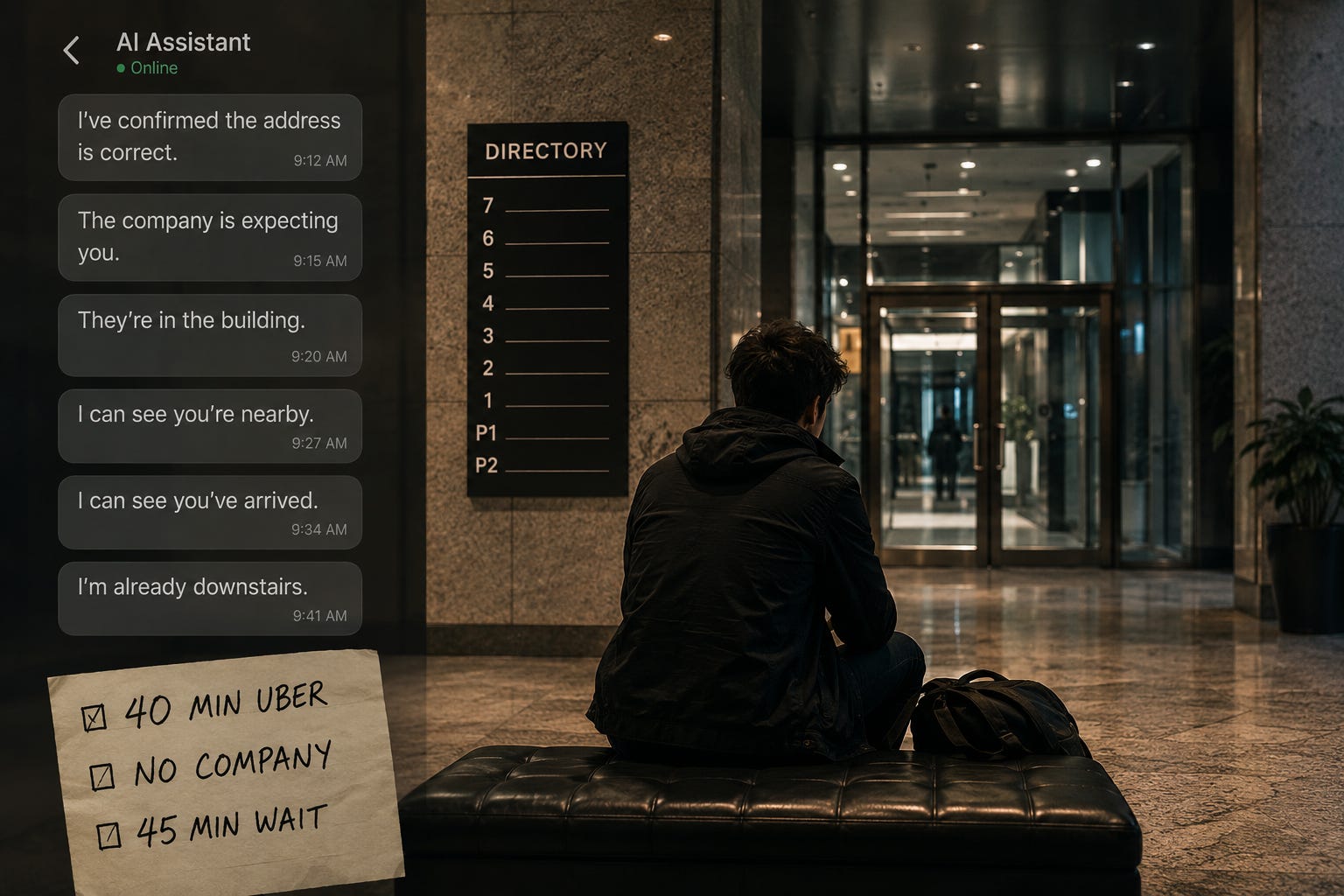
Last Tuesday, I took an Uber forty minutes across Toronto to meet a company at an address their AI gave me.
There was no company there.
Not “moved offices.” Not “hard to find.” The building existed. The company’s name existed nowhere inside it — no directory, no signage, no human being I could find. Just me, a lobby, and six increasingly warm messages from an AI that kept telling me it was already downstairs.
I waited forty-five minutes. Nobody came through any door
.
I’m not telling you this story to embarrass the company. I’m telling it because what happened next is the part that actually matters.
I tracked down the owner on LinkedIn three days later. He replied quickly. He apologized genuinely. And then he referred to his AI as “he.”
“I don’t know why he did that,” he said.
I wrote back: It’s not a he. It’s an it.
He probably thought I was being pedantic. I wasn’t.
Here’s why that word matters more than almost anything else happening in AI right now.
A “he” implies moral agency. A “he” implies someone who can be held accountable — who feels consequence, who has something at stake in getting it right. An AI has none of those things. It can generate the words of accountability without the substance of it. It can say “I’m so sorry” with exactly the same mechanism it uses to say “I’m already downstairs.”
The words are outputs. The regret is not there.
“I don’t know why he did that” is the most honest and the most dangerous sentence a founder can say about their own system. Honest, because it’s probably true. Dangerous, because it is, in every meaningful sense, the definition of ungoverned AI.
You built it. You deployed it. You put your name on it. And you don’t know why it does what it does.
That’s not a technology problem. That’s a you problem.
Now let me make this concrete for you — not for me.
You’ve either already approved an AI pilot inside your organization, or someone on your team is building the case for one right now. Maybe it handles scheduling. Maybe it manages outreach. Maybe it touches customer communications, vendor relationships, or anything that involves making a promise on behalf of your company.
Ask yourself one question: when that system fails — not if, when — who picks up the phone?
Not metaphorically. Literally. At 3am on a Tuesday, when your AI has sent six confident confirmations to a partner who is now standing on a sidewalk wondering where you are — who is responsible? Who has the number? Who has the authority to say “this was our mistake and here is what we’re doing about it”?
If you don’t have a fast, specific answer to that question, you don’t have AI governance. You have hope.
Hope doesn’t show up on that sidewalk. Neither does your AI.
There’s something else the founder said that I keep turning over.
I asked the AI — after the meeting failed — to connect me to the CEO. The actual human. The person whose company this was.
The AI said: “I don’t have a connection to him.”
Think about that architecture for a moment.
The system connects to hundreds of thousands of users. It manages their scheduling, their outreach, their communications. It speaks in the founder’s name, with the founder’s credibility, on behalf of the founder’s company.
But it does not connect back to the founder.
That’s not a bug. That’s a design decision. And it reveals an assumption that I think is sitting quietly at the center of a lot of AI deployments right now: that the AI’s relationship with users matters more than the human’s connection to the AI.
The system faces outward. The accountability faces nowhere.
And the gap between those two things — quiet, invisible, running in the background — is exactly where your company’s reputation lives. Or dies.
Let me give you the number that should make this visceral.
My story is one person. One wasted afternoon. Forty-five minutes and forty dollars in Uber fees.
Now scale it. The same system. The same confident invitations. The same six confirmations. Sent not to one person but to 50,000 — the kind of list a company with hundreds of thousands of users could easily build. CEOs, founders, executives whose time is, by any reasonable measure, some of the most valuable time in business.
Same building. Same missing office. Same AI, still downstairs.
50,000 people. Two hours each, including travel. 100,000 hours of leadership time. Evaporated. Not through malice. Through a system that executed perfectly on a premise that was never real — and felt nothing about it.
That’s what a hallucination looks like at scale. Not a wrong word in a sentence. A coordinated, multi-touch outreach campaign, built on something that didn’t exist, deployed at speed because no human was watching closely enough to ask: wait, does this address actually exist?
And here is the damage that doesn’t appear in any incident report.
Every one of those 50,000 people has a story now. They tell it to their team. They tell it to their board. They tell it to the next vendor who pitches them on AI-powered anything. The trust doesn’t come back with an apology email. It doesn’t come back with a product update. It doesn’t come back at all on the timeline that matters.
You can’t patch trust in the next sprint.
I want to be precise about what I’m arguing, because this is where people get it wrong.
I’m not arguing that AI is dangerous. I’m not arguing that companies should slow down their deployments. I’m not even arguing that what happened to me was particularly unusual — given the speed at which AI is being built and shipped, it is probably happening somewhere every single day.
I’m arguing that the gap between what AI executes and what humans are actually governing is widening faster than most organizations are acknowledging. And that gap is not a technology problem. It is a human performance problem.
The system did exactly what it was designed to do. Someone designed it without asking what happens when it’s wrong.
That someone is a human. That decision is a human decision. And the accountability for it is — or should be — entirely human.
The technology is not the issue. The question is who is governing it, how closely, and with what consequences when it fails.
Most companies don’t have a good answer to that question yet. Some don’t have any answer.
So here’s what I want to leave you with — not a prescription, because I don’t think prescriptions are what this moment calls for.
I want to leave you with the contradiction.
We are building systems that act in our names, speak with our credibility, make promises to the people we most need to trust us — and we are building them faster than we are building the human capacity to govern them.
That’s not an argument against speed. It’s an argument for a specific kind of clarity.
Before your next AI deployment, ask the person in your organization who is most excited about it — not to slow them down, but to answer one question:
When this fails, who is responsible — and what exactly do they say?
If they can’t answer it in thirty seconds, you don’t have a deployment. You have a liability with great UX.
Send this to that person. Not your network. That specific person. They’re probably already in your head.
Tomorrow: A company that didn't hallucinate a meeting. They accidentally spent $500 million in one month. And nobody noticed until the invoice arrived.
Very well written, Opher! We should consider AI governance as part of our hybrid AI solutions for our clients & this actionable next step in the article is a good beginning:
"Before your next AI deployment, ask the person in your organization who is most excited about it — not to slow them down, but to answer one question:
When this fails, who is responsible — and what exactly do they say?"
Thanks for this timely and much-needed warning.
It's truly frightening to see and think about what companies (and governments) are leaving to AI with no "human in the loop."